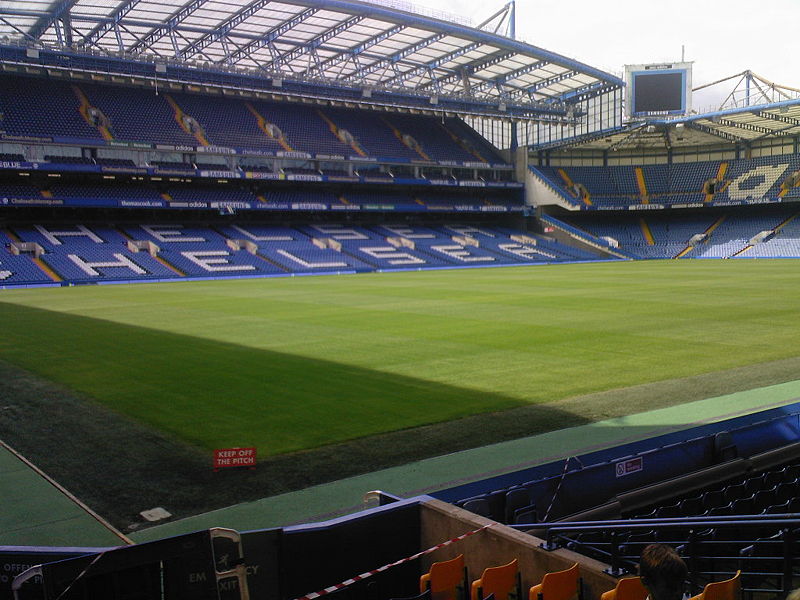
Chelsea's home ground---Stamford Bridge
Chelsea have only ever had one home ground, Stamford Bridge, where they have played since foundation. It was officially opened on 28 April 1877. For the first 28 years of its existence it was used almost exclusively by the London Athletics Club as an arena for athletics meetings and not at all for football. In 1904 the ground was acquired by businessman Gus Mears and his brother, J T Mears, who had previously acquired additional land (formerly a large market garden) with the aim of staging football matches on the now 12.5 acre (51,000 m²) site.
Stamford Bridge was designed for the Mears family by the noted football architect Archibald Leitch.They offered the stadium to Fulham Football Club, but the offer was turned down. As a consequence, the owners decided to form their own football club to occupy their new ground. Most football clubs were founded first, and then sought grounds in which to play, but Chelsea were founded for Stamford Bridge. Since there was already a football club named Fulham in the borough, the founders decided to adopt the name of the adjacent borough of Chelsea for the new club, having rejected names such as Kensington FC, Stamford Bridge FC and London FC
Starting with an open bowl-like design and one covered terrace, Stamford Bridge had an original capacity of around 100,000.[20] The early 1930s saw the construction of a terrace on the southern part of the ground with a roof that covered around one fifth of the stand. It eventually became known as the "Shed End", the home of Chelsea's most loyal and vocal supporters, particularly during the 1960s, 70s and 80s. The exact origins of the name are unclear, but the fact that the roof looked like a corrugated iron shed roof played a part. During the late 1960s and early 70s, the club's owners embarked on a modernisation of Stamford Bridge with plans for a 50,000 all-seater stadium. Work began on the East Stand in the early 1970s but the cost almost brought the club to its knees, and the freehold was sold to property developers. Following a long legal battle, it was not until the mid-1990s that Chelsea's future at the stadium was secured and renovation work resumed.The north, west and southern parts of the ground were converted into all-seater stands and moved closer to the pitch, a process completed by 2001.
The Stamford Bridge pitch, the freehold, the turnstiles and Chelsea's naming rights are now owned by Chelsea Pitch Owners, a non-profit organisation in which fans are the shareholders. The CPO was created to ensure the stadium could never again be sold to developers. It also means that if the club moves to a new location, they could not use the Chelsea FC name.
The club plans to increase its capacity to over 50,000. Owing to its location in a built-up part of London on a main road and next to two railway lines, fans can only enter the stadium through the Fulham Road entrance, which places severe constraints on expansion due to health and safety regulations.As a result, Chelsea have been linked with a move away from Stamford Bridge to sites including the Earls Court Exhibition Centre, Battersea Power Station and the Chelsea Barracks. However, the club have reiterated their desire to keep Chelsea at their current home
Crest
Since the club's foundation, Chelsea have had four main crests, though all underwent minor variations. In 1905, Chelsea adopted as their first crest the image of a Chelsea pensioner, which obviously contributed to the "pensioner" nickname, and remained for the next half-century, though it never appeared on the shirts. As part of Ted Drake's modernisation of the club from 1952 onwards, he insisted that the pensioner badge be removed from the match day programme in order to change the club's image and that a new crest be adopted. As a stop-gap, a temporary emblem comprising simply the initials C.F.C. was adopted for one year. In 1953, Chelsea's crest was changed to an upright blue lion looking backwards and holding a staff, which was to endure for the next three decades. This crest was based on elements in the coat of arms of the Metropolitan Borough of Chelsea[ with the "lion rampant regardant" taken from the arms of then club president Viscount Chelsea and the staff from the Abbots of Westminster, former Lords of the Manor of Chelsea. It also featured three red roses, to represent England, and two footballs. This was the first club badge to appear on shirts, since the policy of putting the crest on the shirts was only adopted in the early 1960s.
In 1986, with new owners now at the club, Chelsea's crest was changed again as part of another attempt to modernise and to capitalise on new marketing opportunities. The new badge featured a more naturalistic non-heraldic lion, yellow and not blue, standing over the C.F.C. initials. It lasted for the next 19 years, with some modifications such as the use of different colours. With new ownership, and the club's centenary approaching, combined with demands from fans for the club's traditional badge to be restored, it was decided that the crest should be changed again in 2004. The new crest was officially adopted for the start of the 2005–06 season and marks a return to the older design of the blue heraldic lion holding a staff. As with previous crests, this one has appeared in various colours, including white and gold.
